The Quiet Engine
Interest that earns interest sounds almost too plain to matter. Imagine S$1,000 earning a 7% annual return. Year one, it earns S$70. Now the money works on S$1,070 instead of S$1,000 — so year two, it earns a little more. Every year, the base grows, so the return grows with it. The machine runs on its own output. Nothing about it is dramatic; that is the point.
Almost everything in investing that feels exciting is a distraction from this engine. The engine only needs two inputs: time, and the discipline not to interrupt it.
How Fast It Doubles: The Rule of 72
To see how powerful that engine gets, use the rule of 72: divide 72 by the annual return to get the approximate number of years for money to double. At 7%, that is roughly every ten years.
So S$10,000 invested once at 7% looks like this over four decades:
- 10 years: ~S$20,000
- 20 years: ~S$40,000
- 30 years: ~S$80,000
- 40 years: ~S$160,000
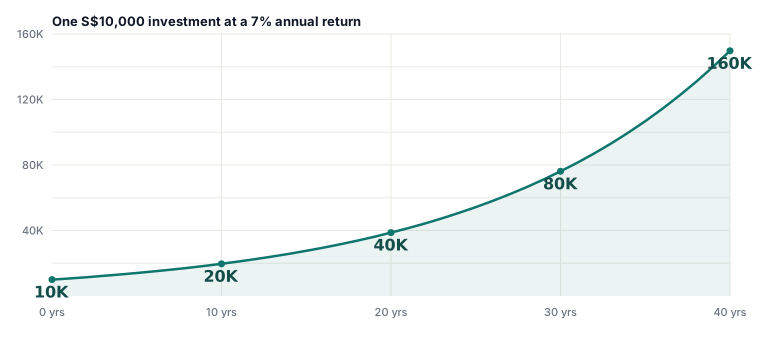
Notice what happens in the last decade: the money adds more in those ten years than it did in the entire first twenty. Early on, compounding looks like a flat line; decades later, it looks like a cliff. Investors give up during the flat part and then miss the cliff.
Ten Years Early Is Roughly Double
Same plan, same amount, same 7% return, same retirement age. One investor starts at 35, the other at 25. At the end, the earlier starter has roughly twice as much — not because they invested more, but because they had one extra doubling period at the end of the run. The extra decade is the whole difference.
Ten years does not feel like a doubling of effort; it feels like starting five minutes earlier. That is the deception. The calendar does not care how the difference feels.
Fees and Taxes Are the Silent Drains
Compounding runs in both directions. A 1% difference in fees or taxes does not look painful in any single year — but over 40 years, a 7% return becomes a 6% return, and that is the difference between roughly S$15,000 and S$10,000 growing from the same S$1,000. A "small" cost quietly eats roughly a third of the ending number.
This is why the low-cost habit matters more than any clever position. It is also where Singapore makes the math friendlier: the interest on Savings Bonds and T-bills is exempt from personal income tax, and SRS contributions defer tax on the money that is busy compounding — growth you keep in full while it works.
The Only Way to Break It: Interruption
The engine has exactly one failure mode: being interrupted. A forced withdrawal during a downturn, a panic sale, a "pause" that never ends — each one stops the compounding on that money permanently. That is what your emergency fund is for, and why dollar-cost averaging exists: so that a bad month never forces you to take the money away from the clock.
The Takeaway
You cannot choose the return, but you can choose how long the money works and how little you interrupt it. Start as early as the calendar allows, keep costs and taxes low, and leave the engine alone. Every number on this site eventually distills to that.